Wednesday, 19 February 2014

DIY Sous Vide: Outlining the task ahead

I started hearing about accurately controlled water baths used in cooking a few years ago, but only took an interest in them when talking food with one of the staff at my favourite café. He'd been playing with sous vide at home using one of the new controllers that quite neatly take a plug-in slow cooker or rice cooker and turn it into a precise water bath.

Trying to cook some pieces of the notoriously temperamental kangaroo a few weeks later, I tried my hand at a crude and labour-intensive water bath. It involved a digital thermometer suspended in a pot of water, a gas stove, and almost constant manual adjustments. Extreme 'though this effort was, the tenderness of the resulting meat made a sous vide setup extremely tempting.

The existing home controllers sound great, but I enjoy designing and building my own cheap workarounds, not just buying someone else's. So that is my project: design and build a simple-to-operate sous vide waterbath.

Of course, sous vide presents a few problems. Firstly, the systems I'm trying to control run on 240V, well above the limit I'm allowed to work on without being a licensed electrician*. So I'll be attempting to work out an ELV (extra-low voltage) system to control the LV 240V components. I know that most DIY solutions involve illegal 240V wiring, but I'll try to keep this design above board. The proximity of electronic components to water is also a problem, but one that is far easier to overcome.

To guide me on my way through this project, here are the basic principles I'm trying to stick to:
  1. Wiring is to be legal (although this should go unsaid, it generally can't when the DIY initialism gets involved with electricity)
  2. As much as is possible, components are to be homemade
  3. Unit must be small enough to fit into our already crowded kitchen storage
  4. While in use, waterbath temperature must be maintained at set-point ±0.5°C while food is being added, and have a steady state temperature of set-point ±0.2°C.


Breaking up the design:
Sous vide systems consist of a few basic parts, some of which I'll be making and others I'll probably have to buy.

  • #1 Water Heater: DIY systems typically use either an off-the-shelf slow cooker/rice cooker, or a plastic tub and the heating element from a kettle. If I can find a legal way to do it, a variant of the latter approach appeals to me far more than the former.
  • #2 Water Circulation: Neglected in many home systems (including the commercially produced ones), appropriate water circulation through the water bath is critical for maintaining consistent temperatures. Otherwise distinct hot- and cold-spots will develop.
  • #3 Temperature Sensor: For simplicity and reliability, this will probably be a purchased thermocouple probe connected to my controller.
  • #4 Temperature Controller: This encompasses a range of sub-systems, including: input from the temperature probe, set-point adjustment and display, temperature display,  PID feedback control, feed-forward control (not really necessary, but I have been itching for an excuse to use it for a few years and I'll be trying to find a way to incorporate it into this) and a PWM output.
  • #5 Switching Module: The simplest product for this would be a SSR (Solid-State Relay) wired between the water heater and the 240V outlet, but that falls prey to the whole problem of being illegal.


Now, the keen among you may well point out that the entirety (apart from the feed-forward control) of #4 could be supplied by an off-the-shelf PID temperature controller, countless examples of which are available for purchase across the internet, but I do really want to integrate feed-forward control if possible, and most of these systems suffer from a few issues that I'll outline later.

* Those among you who are endowed with good memories may recall that I was an Electrical Engineer before retiring a little over a year ago, but being allowed to write a specification for an 11,000V generator is not the same as being allowed to tighten the screw on a 240V junction box.

Friday, 14 February 2014

Stop by Tunnel Vision Café for your morning brew

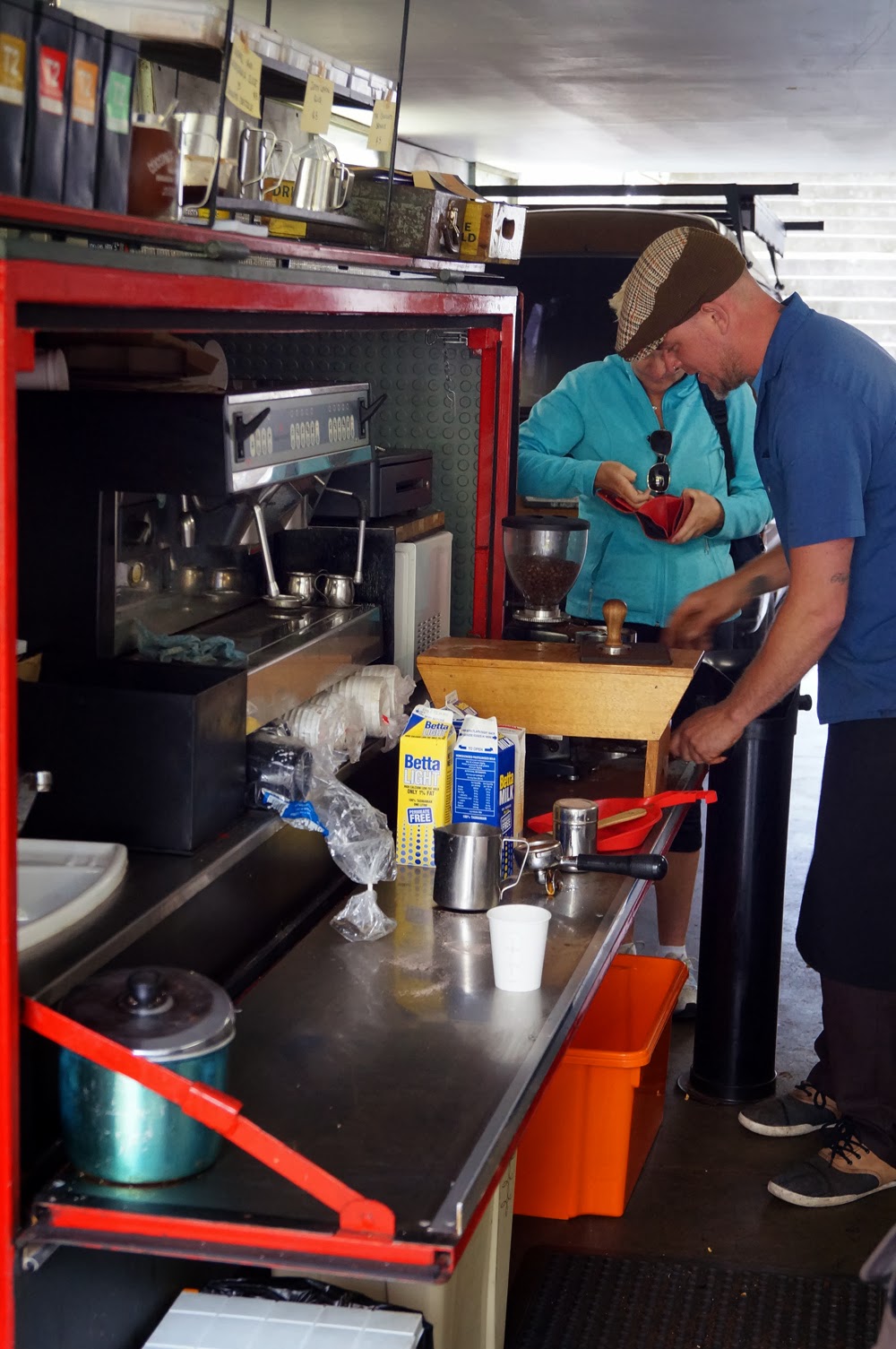
If you're making your way between the Hobart Aquatics Centre and the CBD, you might notice something odd when passing through the Railway/ABC/Fountain Roundabout: a van and trailer parked in the underpass. Odd though this may seem, the surrounding chairs and the wafting smell of coffee should explain its presence easily enough.

Tunnel Vision opened its trailer's doors in February 2013, and I was fortunate enough to come across this eccentric café just in time for its first birthday. Most of those who make their way through the tunnel are apparently determined not to say hello, let alone stop, but Tunnel Vision is building up a client base of regular customers. David—the café's owner—has an impressive memory for faces and knows many of his customers' usual orders well enough to start brewing before they have a chance to ask.

It's not difficult to see why those who do stop would choose to keep on stopping in the future. Tunnel Vision uses Five Senses Coffee, a West Australian roastery that has recently expanded to Victoria. The beans pour surprisingly well as a black coffee (impressively so for a blend) and superbly as a milk coffee. And if coffee isn't your thing, the other drinks on offer should more than make up for it. David makes his own syrup for chai lattes, a lightly spiced concoction with more subtlety than the usual sickly sweet mixes on offer. The real winner of the drinks menu is the spiced hot chocolate, flavoured with homemade ganache and chilli jam. This rich beverage, touched with hints of cinnamon and chilli, is an absolute must-try and ranks as one of the best spiced hot chocolates I've ever tasted.

A few chairs and picnic blankets are provided in case you feel like stopping for a while. After a full sit-down breakfast? The menu is limited to waffles, but the range of toppings on offer is anything but. Or you could just stand and chat with David for a while, sipping a drink from his most unusual cafe.

Monday, 27 January 2014

Canberra: In Pursuit of the Perfect Cuppa

Canberra sports a wide variety of coffee roasters and cafes, which range from the Melbourne-esque Lonsdale Street Roasters to ONA Coffee's South American themed Cupping Room. There is Gus's, laying claim to Canberra's first outdoor cafe seating, and Sly Fox, erected on trestle tables and milk crates each morning. Amid all the choices on offer, these are a few of my favourite Civic and Inner North* cafes.


#1 The Cupping Room, corner University Ave and London Cct, Civic
A relatively new arrival in Canberra, The Cupping Room is the latest venue to be opened by the award-winning Canberra coffee roasters, ONA Coffee. As well as their exceptional house blends, they serve a wide variety of single origin coffees that are each matched to different brewing methods.

Service staff, baristas and roasters are all friendly, knowledgeable and happy to discuss every detail of the coffee process, from different bean varieties and farm locations right through roasting and preparation to the beverage in your cup. Coffees are delivered to the table with tasting notes and the background story for each batch of beans.


The Cupping Room’s kitchen produces a wide variety of experimental dishes and classic favourites with a South American twist. There are several vegan and gluten free options on the menu, and they are happy to modify other dishes to meet dietary needs. The Cupping Room does not offer muffins or other quick takeaway snacks, but makes for a superb venue for a sit-down breakfast or lunch in Civic.

#2 Wilbur's, 14 Hackett Pl, Hackett
A true hidden gem, Wilbur's is an unassuming cafe-bar located in Hackett. At first glance, it's just a bar with a lunch menu and a coffee machine. Second glance doesn't reveal much more, but give them the chance and they'll give your tastebuds a treat to remember. The menu offerings are mostly on the bar snack end of the culinary scale, but their cake fridge is another matter. Don’t be fooled by the setting; these cakes make for superb treats and would comfortably compete with a fine French gateau.


Wilbur’s brews coffee from a Sydney roaster, Di Stefano. Although Di Stefano is far from a renowned coffee roaster, Wilbur’s prepares the beans well in both their milk-based and black coffees. While its location makes it less than ideal for a quick lunch-break visit, Wilbur’s is a great place to stop in on the way back from the Saturday Farmers Market or on a lazy Sunday.

#3 Lonsdale Street Roasters, 7 Lonsdale St, Braddon
An outpost of the Melbourne hipster cafe scene, Lonsdale Street Roasters runs two cafes on the street that gives them their name. The roastery, at number 23, is focused on the coffee, with a blackboard outside giving only a limited range of food options. Wander a few shops down to number 7 and you'll find a markedly different venue. The walls are decorated with bicycles and a line of blackboards listing a more extensive menu. Retro light fittings illuminate a case filled to bursting with pastries from the Flute Bakery.

The menu at number 7 is largely dominated by a variety of paninis. The flavours on offer vary significantly, with a more exciting array than the usual choice of chicken & avocado, sundried tomato & olive, or ham, cheese & tomato. Goats’ cheese, lamb, braised pork, prosciutto and chorizo were some of the ingredients to make an appearance. However, the large menu offers only vegan cupcakes or gluten free fruit with yogurt for those with dietary restrictions. If your diet is unrestricted, you will find that the pastries on offer are excellent and the paninis are both varied and delicious.


Lonsdale Street Roasters serves excellent long blacks with complex flavours, using their various single origin beans. However, a few of the blends used for their milk-based coffees leave something to be desired. While palatable, the bland flavour profile is what might be expected from mass-produced coffee rather than a small roaster. Extensive hard surfaces and loud background music are certainly in keeping with the hipster vibe, but make it a poor choice venue for a sit-down lunch. Instead, take advantage of its pastries and paninis, coupled with its proximity to Civic, and grab yourself a quick takeaway breakfast or lunch.

#4 Sly Fox, Inner North cycle path between Macarthur Ave and David St, O’Connor
Sly Fox is quite unlike the other cafes on this list, being neither a roastery nor a hidden gem out in the suburbs. They accept bitcoins as payment—the first Canberra cafe to do as such—but the most significant difference from their rivals is their complete lack of either roof or walls. Patrick sets up his trestle table counter beside the Inner-North bike path to catch the weekday rush of commuters cycling to work. Sporting an awning when the weather turns foul and running off a small generator, Sly Fox is a “venue” worth visiting.

They serve Lonsdale Street Roasters coffee, and prepare it well, but don’t think of this as just another place you can stop in and grab a takeaway coffee on the way to work. While they’re presented in paper cups you could sip along the ride to work, it’s worth stopping for a few minutes and pulling up a milk crate. The resident bike mechanic can tune your bike while you breakfast on coffee and Sly Fox’s food of the day. There is no set menu, nor much chance of finding the same food there twice. Instead, Patrick brings in whatever has inspired him for that day. Perhaps you’ll find fresh fruit salad and yogurt, an upside-down cake, or even his mum’s secret recipe spiced date scones. Every time I catch myself dismissing Sly Fox as a gimmicky venue, more about the setting and convenience than the produce, I remind myself of the delicious food I’ve tried there.

#5 The Fresh Roast Coffee House, 30 Kemble Ct, Mitchell
While Jindebah Hills is easily Canberra’s most award-decorated coffee roaster, the small cafe attached to their roastery is not widely known. Visitors could be forgiven for underestimating it, given the semi-industrial surrounds and almost non-existent food offerings.


Little emphasis is placed on presentation, and latte art—seemingly a must in every cafe—is conspicuously and intentionally absent from their coffees. But even lacking a delicious menu or outstanding presentation, The Fresh Roast is made exceptional on the grounds of their coffee alone. Complex, rich and varying flavours abound in their single origin and blended coffees. The couple of staff members who keep the place going are happy to discuss their produce and the history of the business.


While the lack of food on offer makes The Fresh Roast a poor choice for a meal, they make an excellent stop if all you want is good coffee.

* I know there are many excellent cafes south of the lake—and have enjoyed visiting several of them—but reviewing those will have to wait until I've made a more extensive sampling of their ranks.

Wednesday, 22 January 2014

Sorbets: A dash of liqueur and a sprinkle of SCIENCE!

A few recent experiments trying to make sorbets and icecreams without an icecream maker were reasonably successful, but suffered from a need for supervision. The frozen goodies had to be removed from the freezer and stirred/blended thoroughly several times to get a good texture, and still tended to become too hard for my tastes. I would probably have continued making them in this laborious fashion for some time to come, had I not been given a burst of inspiration by my partner. She suggested I make some sorbet using leftover ALDI apple schnapps as flavouring. Not only did this promise to be an exciting sorbet, but I realised it could solve all the problems of preparing sorbet without an icecream maker.

The purpose of all the stirring and blending of sorbets while freezing is to avoid large ice crystals, which turn smooth icecream into solid ice. Ideally, the finished product freezes only just enough to stop being liquid, without ever hardening fully. Most sorbets are at this ideal point straight out of the icecream maker or after a day or so of freezing. But even the best sorbet will often start hardening over the following days. By dropping the freezing point closer to a residential freezer's set temperature of -20°C, there is the potential to stop this from happening.
Ah ha! It's time for SCIENCE!
Alcohol freezes at a lower temperature than water. In fact, with a melting point of -114°C, it freezes at a lower temperature than carbon dioxide. DDBST has data for the freezing points of ethanol (non-poisonous alcohol) combined with water in different molar ratios. Some algebra (it's been a while, but I still remember the basics) produced a liquid-solid phase diagram for methanol and water with a more useful scale. Adding sugar affects the vapour pressure according to Raoult's Law, which further decreases the melting point and... sod it.

In the end, I made my usual sugar syrup, added schnapps until it tasted good and then tried freezing the results...

Twelve hours later, I gave it a quick stir to break up a few large ice crystals that had formed around the top, and put it back in the freezer. By this stage, my other sorbet would have already frozen through, but the liqueur sorbet was being more resistant and was still resolutely slushy.

Another twelve hours and it had hardened as much as it was likely to, forming a soft sorbet without a trace of sharp ice crystals. The method (splashing stuff in and seeing what happens) certainly needs some refinements in quantities, but the sacrifice (of making and eating sorbet) is one I am willing to make...

Next into the freezer: ALDI* triple sec orange sorbet.

* I'm not sponsored by ALDI, but I do like buying cheap liqueurs from them for my experiments.

2013 - A year in video review

So, it's been quite some time since my last post. First there was Christmas (whose adventures now need to be belatedly recorded here) and then I spent a few weeks trying to remember how to use the video editing software that had been gathering dust on my computer. My partner and I had gathered all our raw video footage from the year and set each other the challenge of compiling something from it.

Compiling, it turned out, was easier said than done, but nothing against the challenge of getting my old CS4 version of Adobe Premiere to output a usable file. I had forgotten the suffering that entailed. But it is done at last, and I've uploaded it to the interwebs for the judgement of the world.

2013 - A Year's Adventures from Nick Ward on Vimeo.

Saturday, 30 November 2013

ONA Coffee's Cupping Room

ONA Coffee has just opened a new outlet in Civic, the Cupping Room, and it's a must-see for any Canberran or visiting coffee connoisseur.

ONA Coffee has been roasting their own beans in Canberra since 2007. What they lack in an impressive establishment date is more than made up for with the quality of their product. One of only two ACT coffee roasters to win medals in the Sydney Royal Coffee Competition—a category of the Sydney Royal Fine Food Show that was established in 1998—and operating their own bean sourcing programme direct from coffee farmers in India, Central and Southern America, they have a fast-growing reputation for excellence.

Their Fyshwich Coffee House and Roastery has been a favourite cafe of mine since moving to Canberra, despite its distance from my Northside home. I was more than a little excited to hear they were opening a new café in Civic, and not just because it was right next to the university campus where I spend my weekdays.

Photo courtesy of Jessica Hancock.


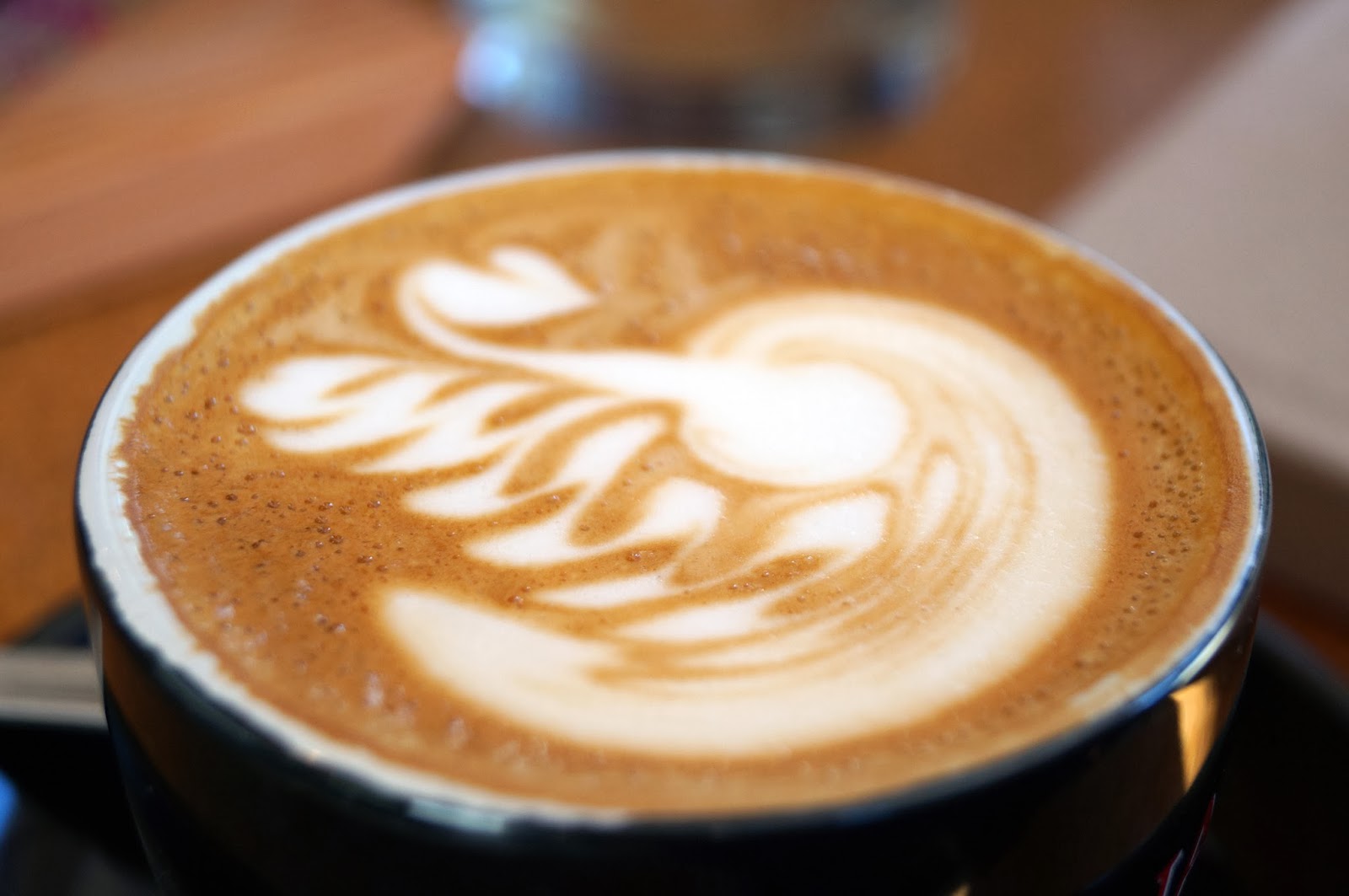
Exquisite latte art, as always.
The doors of the stylish new venue on London Circuit opened last Saturday to admit Canberra's coffee lovers and I arrived soon after. On the advice of the Fyshwick staff, I've swapped my usual brew from latte to a flat white and I started off with an Organic Blend flat white. In most cafés, their organic coffee offering has exchanged excellence for its name. Whereas the organic coffee served by ONA has reached such high quality that they now serve it as their house blend, supplanting the already exceptional Malawian Mocha and ONA Signature blends. Hints of dark chocolate and caramel make it a favourite of mine for any milk based coffee.

Photo courtesy of Jessica Hancock.
The day was warming quickly and another ONA favourite was soon sampled, their cold drip. Stylishly served to match the mad scientist equipment used to produce it, the cold drip is delivered in an old-fashioned medicine bottle with a similarly old-fashioned label. Lacking even a trace of bitterness, cold drip is an ideal drink for anyone still taking their first baby steps in the coffee world. It also makes an excellent summer beverage for even the most discerning of coffee connoisseurs.
The Cupping Room's coffees lived up to the ONA name admirably, but the new venue has something more on offer that sets it apart. Between the espresso machines and the kitchen is an offering new to Canberra: a bar lined with stools, at which a few unusual coffee offerings are prepared. This is the heart of the Cupping Room, the filter bar, where their pourovers are poured, aeropresses are pressed, cold-drips drip slowly away and freshly roasted beans are cupped.

ONA founder, Sasa, prepares pourovers at the Cupping Room's
filter bar. 
Photo courtesy of Jessica Hancock.
Lured in by the mid-week free coffee day, I returned to the Cupping Room with a group of caffeine addicted postgraduates a few days later for a study session. For some, this was their first introduction to ONA and they were generally impressed by what they discovered. One persona non-drinker of coffee, tea or hot chocolate, who found his meal choices restricted by his low-carb diet, dislike of fish and egg, and an aversion to ordering custom dishes—sampled only sips of the coffee on offer, but still enjoyed the atmosphere. Then, as the studying wound to a close, we had the chance to take part in a cupping.

Roaster, Gus, checking the smell of his latest
roasts. 
Photo courtesy of Jessica Hancock.
Cupping is a scene reminiscent of a wine or whisky tasting, with the anonymous coffees lined up along the bar. The "crust" of coffee grounds is first broken to release the aromas of the mysterious brews and then scooped off. The unfiltered coffee beneath is slurped in a most undignified manner, spreading it evenly across the tongue. From these tests, roasters can check the quality of each batch of beans, pick out the individual flavours and refine the roasting process to match. Customers at the Cupping Room have the chance to take part in the process under the guidance of ONA's expert coffee roasters. We were treated to samples of seven different single origin roasts, including a taste of the rare and intensely aromatic geisha, a legendary coffee varietal that has been breaking world price records since its discovery by the world markets in 2004. I was at a loss to describe its powerful aromas and flavours (were those floral notes? Berries, perhaps plums?but could appreciate their exquisite combination.

The Cupping Room's food menu is worth exploring.
Like ONA's other venues, the Cupping Room provides excellent food to accompany their range of espresso, pourover, aeropress and cold brew coffees. Their new menu is a fusion of flavours inspired by South American cuisine, and their all-day breakfasts boast a few unusual takes on the typical Australian offerings.
"Not So Benedict" takes eggs benedict, then adds
silverside and a mustard sauce.
"Dragon Eggs" are avocado halves, filled with mildly
spiced guacamole and topped with poached eggs.
The banana hotcakes include a hint of salt to offset
their sweetness.


Also check out ONA's video, Cup A Wonderful World. Bonus points for spotting the author of this blog.

Friday, 22 November 2013

Homemade Bone Stock

Eating lunch at a recent first aid course, I got a surprise supply of ingredients. The organisers had a couple of supermarket roast chickens to provide some sandwich fillings, the carcasses of which were abandoned at meal's end. I snapped them up quickly and took them home to make myself some stock.

Store-bought stock tends to be tasteless (apart from the overwhelming taste of salt) and I've been a staunch supporter of making my own for a few years. It started when my local shop started packets of turkey bones, wings and necks, all the bits that don't look good in the Christmas family photo. It wasn't December, but enough Australians hold a Christmas-like celebration around June 25th (which is now bizarrely being called Christmas in July, apparently named after the entirely unrelated United States tradition intended to boost retail sales) that turkey can become reasonably prevalent in the frozen section of shops during June. I got a few assorted "offcuts", marinated them and shared a decent meal with some friends. But afterwards, I was left with a pile of bones... and decided to learn how to make stock from them. This recipe is the result of a few adaptations leading up to the present day, and needs little or no adaptation to be used with turkey or beef bones.

Chicken Bone Stock
Ingredients


  • 2 chicken frames
  • 1 onion, skinned and chopped into eighths
  • 1 leek, including green section of stem
  • 1 bunch celery, including leaves 
  • 1 carrot
  • 2 bay leaves
  • 2 sprigs parsley
  • 1/4 C vinegar, apple cider or white wine
  • black peppercorns
  • 2 egg whites, to clarify the finished stock
Directions


  1. Cut chicken frames into chunks and place in your stock pot if it is oven-proof, or spread in a roasting dish if its not. Bake for 15-20 minutes at 180°C (fan forced), turning as necessary, until the pieces are golden brown. Cooking time will vary depending on whether you're using cooked or raw carcasses. Do not allow bones to burn. Take out of the oven and allow to cool.
  2. Chop the green top off your leek and cut it (the green section) into 3cm lengths. This recipe does not require the white flesh, so you can use that for one of the many recipes that demand no green leek be included. Chop the leafy tops off your celery. Again, leaves work just as well as stalk for this recipe, so you can use the stalks elsewhere. Chop carrot into 3cm lengths. Rinse parsley and all vegetables then add to your stock pot.
  3. If you baked the bones in the stock pot, skip ahead to part 4. If you baked your bones in a roasting dish, add these to the stock pot. If there are any juices in the dish, pour these into the pot as well (don't worry if they include chicken fat. You can remove the fat later. If there's any caramelised juice on the dish add some warm to dissolve it and pour this into the pot. 
  4. Add the vinegar (apple cider or white wine), bay leaves and pepper to the pot and pour in enough cold water to cover. Bring to a simmer over medium heat (do not allow to boil vigorously), reduce to low and leave at a gentle simmer for 4 hours.
  5. Straining your stock is easiest if done in a couple of steps and requires another pot or a large bowl big enough to hold your stock, a colander and some muslin or cheesecloth. Place the colander over the second pot. Pour the stock through, discard the chunks left in the colander and rinse your stock pot. Place a piece of cheesecloth in the colander, and place over your stock pot. Pour the stock through.
  6. Now for the egg whites. Keep the colander and second pot handy; you'll need them again. Put the pot of strained stock back on the stove and bring back to a simmer over low-medium heat. Beat egg whites with 2 tablespoons of cold water, then pour into the stock and leave for several minutes. The egg white should form a "raft" on the surface, to which sediment in the stock will bind. Remove from the heat and strain through cheesecloth to remove the egg whites. Place stock in the fridge to cool.
  7. Once cold, any fat in the stock will form as solid crust on the top. Skim this off and your stock is ready for use. It can be used immediately, or frozen in smaller containers for later use.


Stock before and after filtering with egg white.